
Radio-aware smart bulb · ESP32-C3 The lamp that shows you the air.
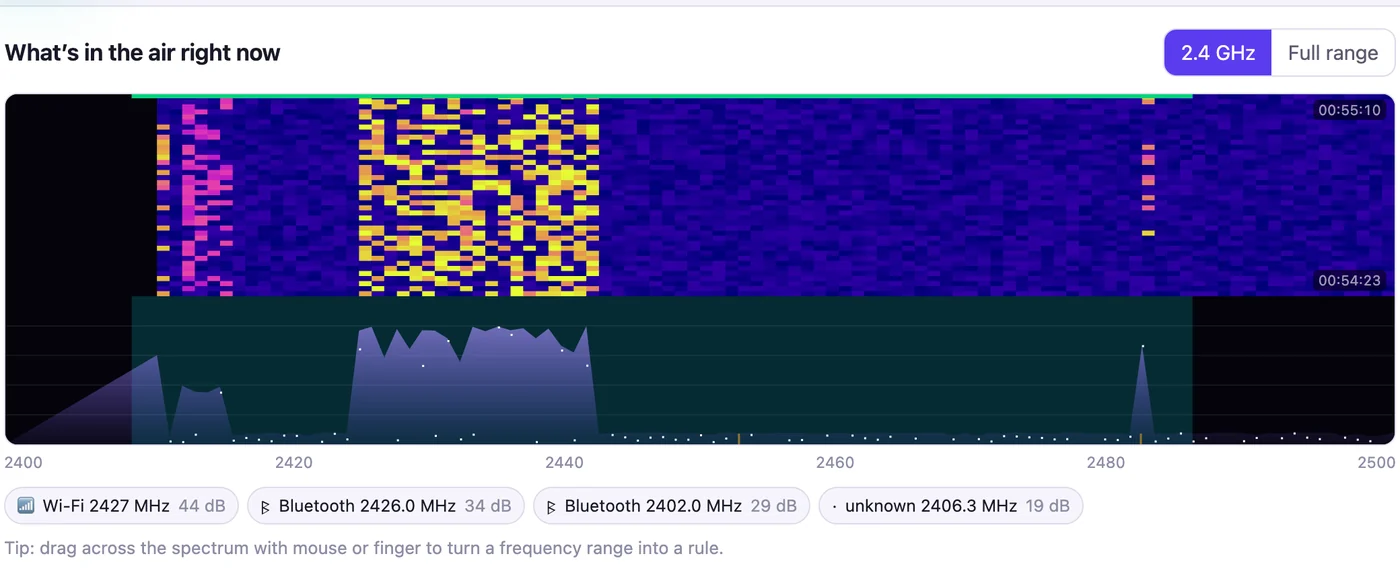
The room around you is full of radio: your Wi-Fi, a phone talking to its earbuds, a smart plug on Zigbee, the cell tower down the road. Etherbulb is firmware for a cheap ESP32-C3 smart bulb. It turns the bulb's own Wi-Fi radio into a receiver and colours the room by what it hears: blue for Bluetooth, green for Wi-Fi, any colour you like for anything you pick. Stronger signal, brighter light.
Three steps to a lamp that listens.
No extra hardware, no hub, no cloud. A thirteen-euro smart bulb with an ESP32-C3 inside, our firmware, and a browser.
Get the bulb
An Athom / IoTorero 12 W RGBCW bulb with the ESP32-C3 chip (model LB01-12W-E27). Pick the ESPHome version, it flashes without opening anything. Where to buy ↓
Flash Etherbulb
Give the bulb your Wi-Fi (Bluetooth from the web flasher, or the bulb's own hotspot), then upload Etherbulb on the bulb's page. About two minutes, no soldering, no app. Flash it ↓
Screw it in, pick colours
Open the dashboard in your browser, click a colour per signal in the colour matrix, set brightness and sensitivity. The bulb lives in your Wi-Fi and listens at the same time.
What it shows, what it doesn't.
The ESP32-C3 is a Wi-Fi chip, not a lab receiver. It hears the 2.4 GHz neighbourhood and a bit around it. Etherbulb classifies signals by their shape and position (width, channel grid, duration). It never decodes contents, and it never transmits on the bands it watches.
Phones, earbuds, trackers, smartwatches. Narrow packets on the 1 MHz grid, incl. the three advertising channels.
Every 2.4 GHz network around you, or just one channel: your own, or the neighbour's.
Smart-home radios on the 2405 + 5·n MHz grid.
FPV drones and wireless cameras on the AV channels 2414–2468 MHz, recognised by their wandering FM carrier.
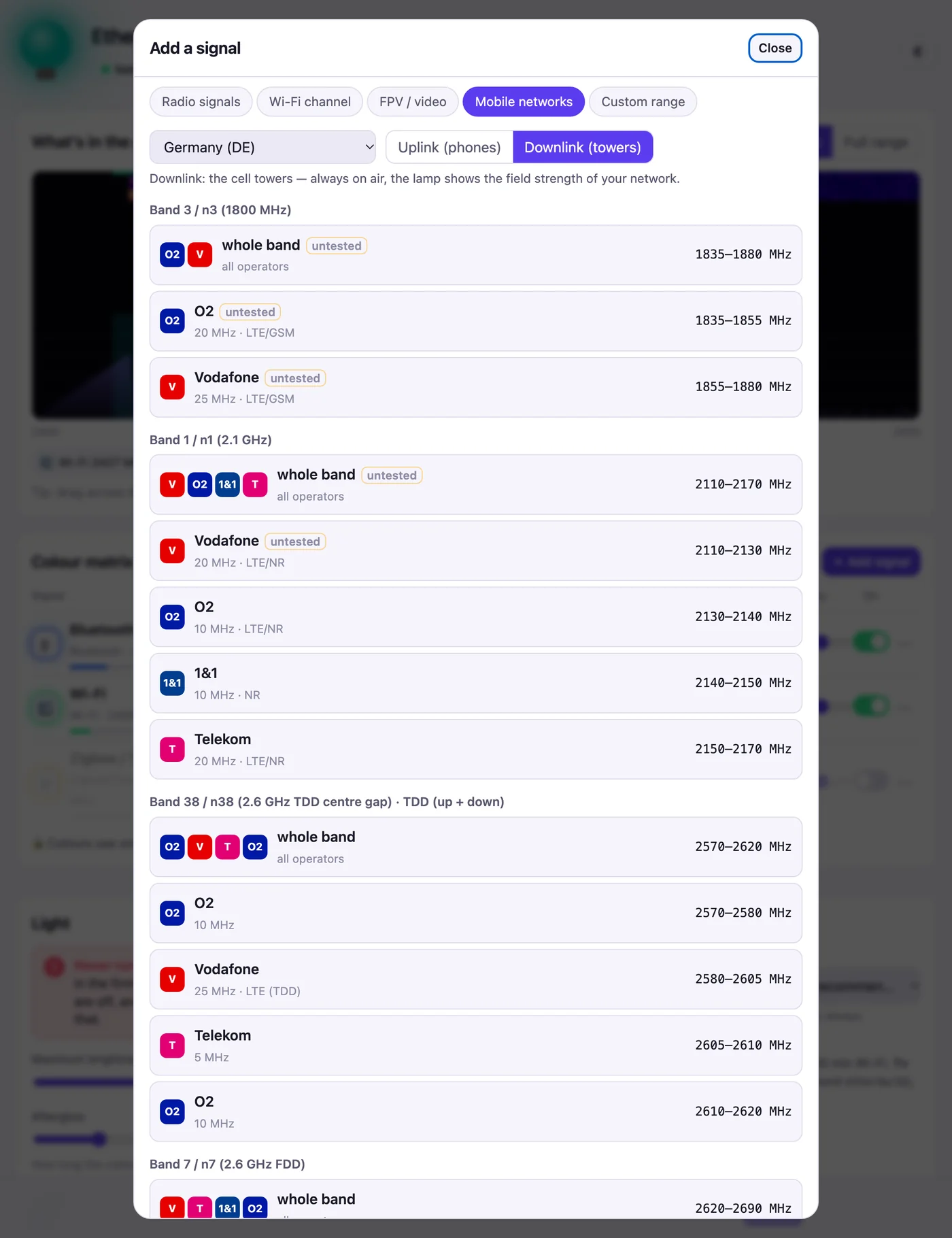
Cell towers (downlink) and phones that are transmitting (uplink) in the bands the chip reaches: Band 1 (2.1 GHz), Band 7 and 38 (2.5–2.69 GHz), 412 operator blocks in 39 European countries.
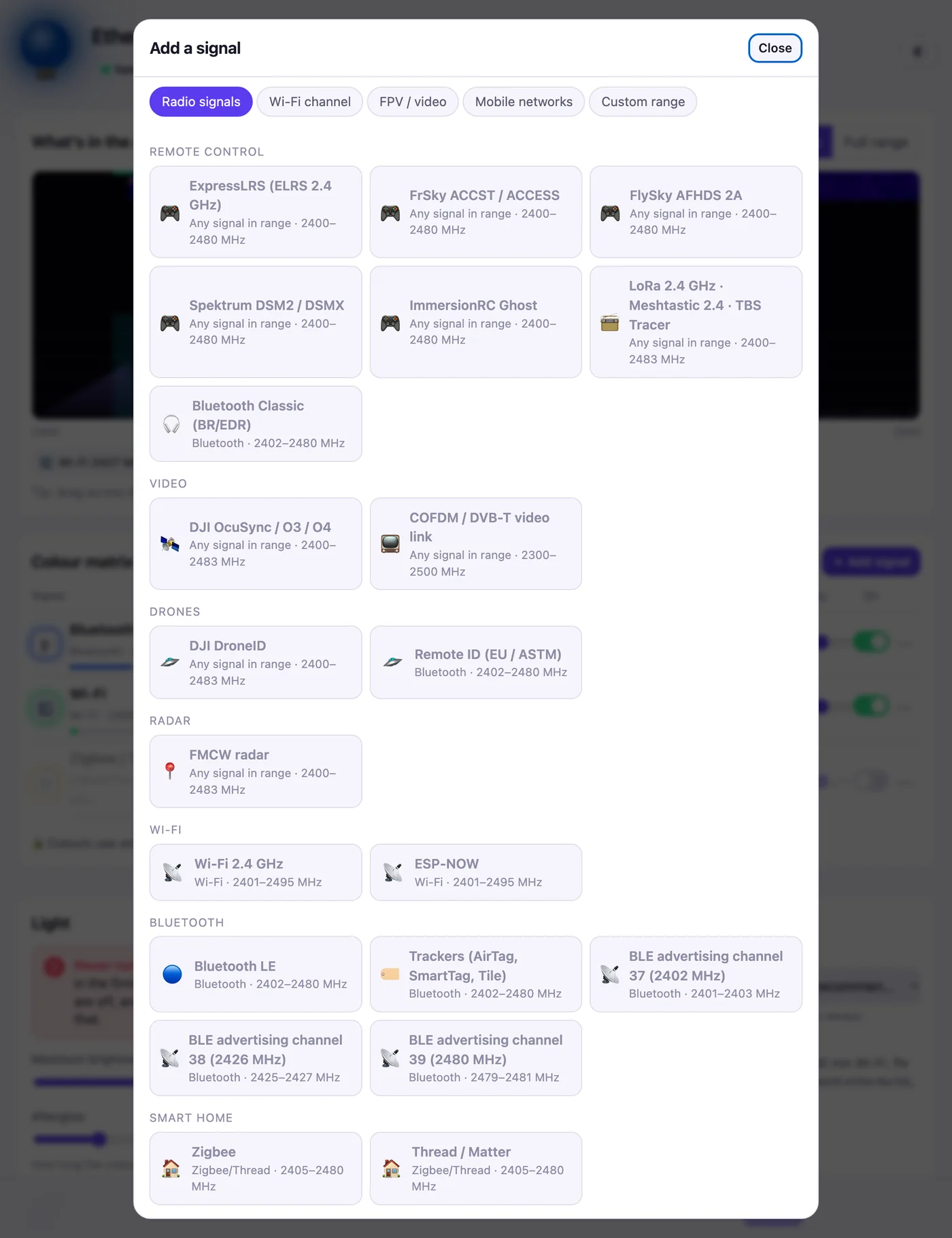
Remote controls (ELRS, FrSky), LoRa 2.4, drones, microwave ovens, or a range you draw yourself in the spectrum.
Runs on the bulb. Opens in your browser.
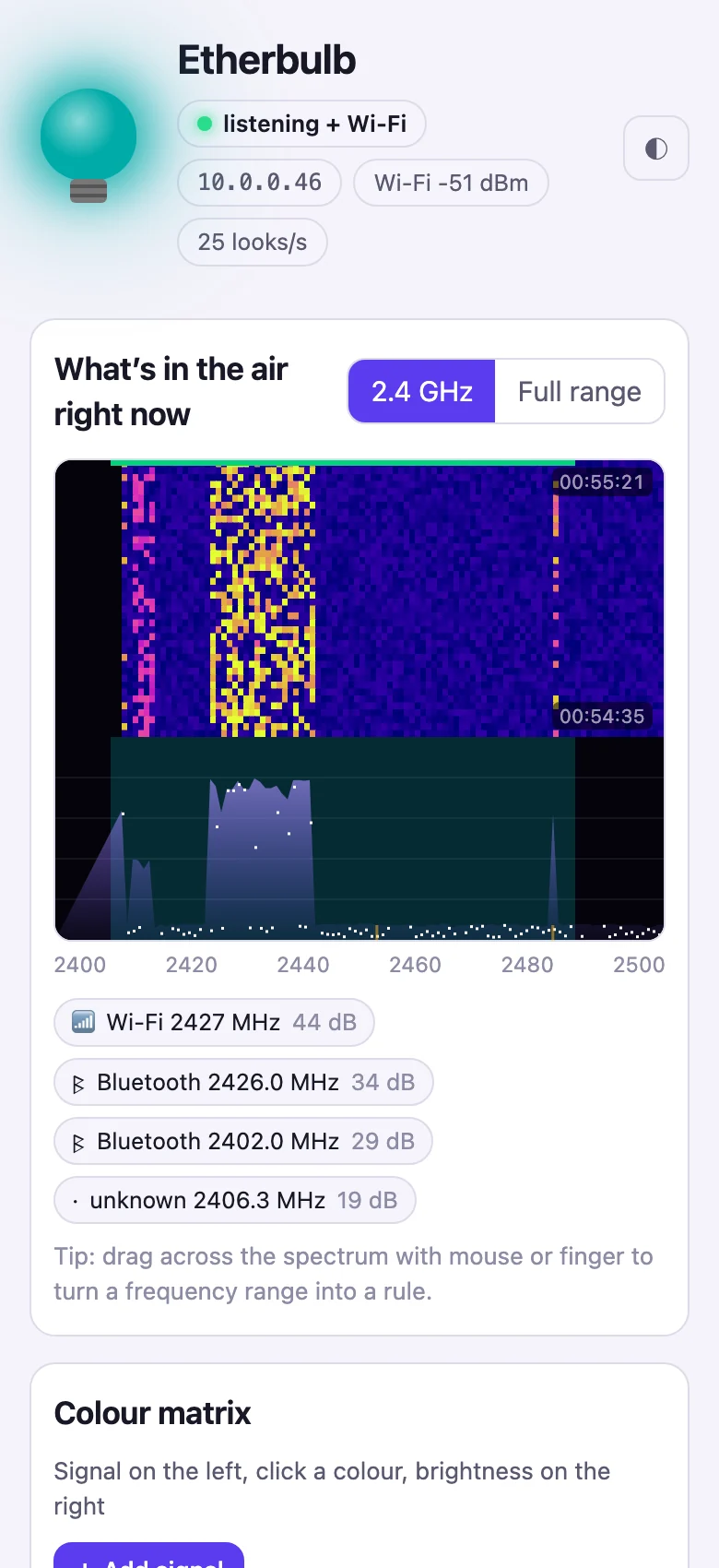
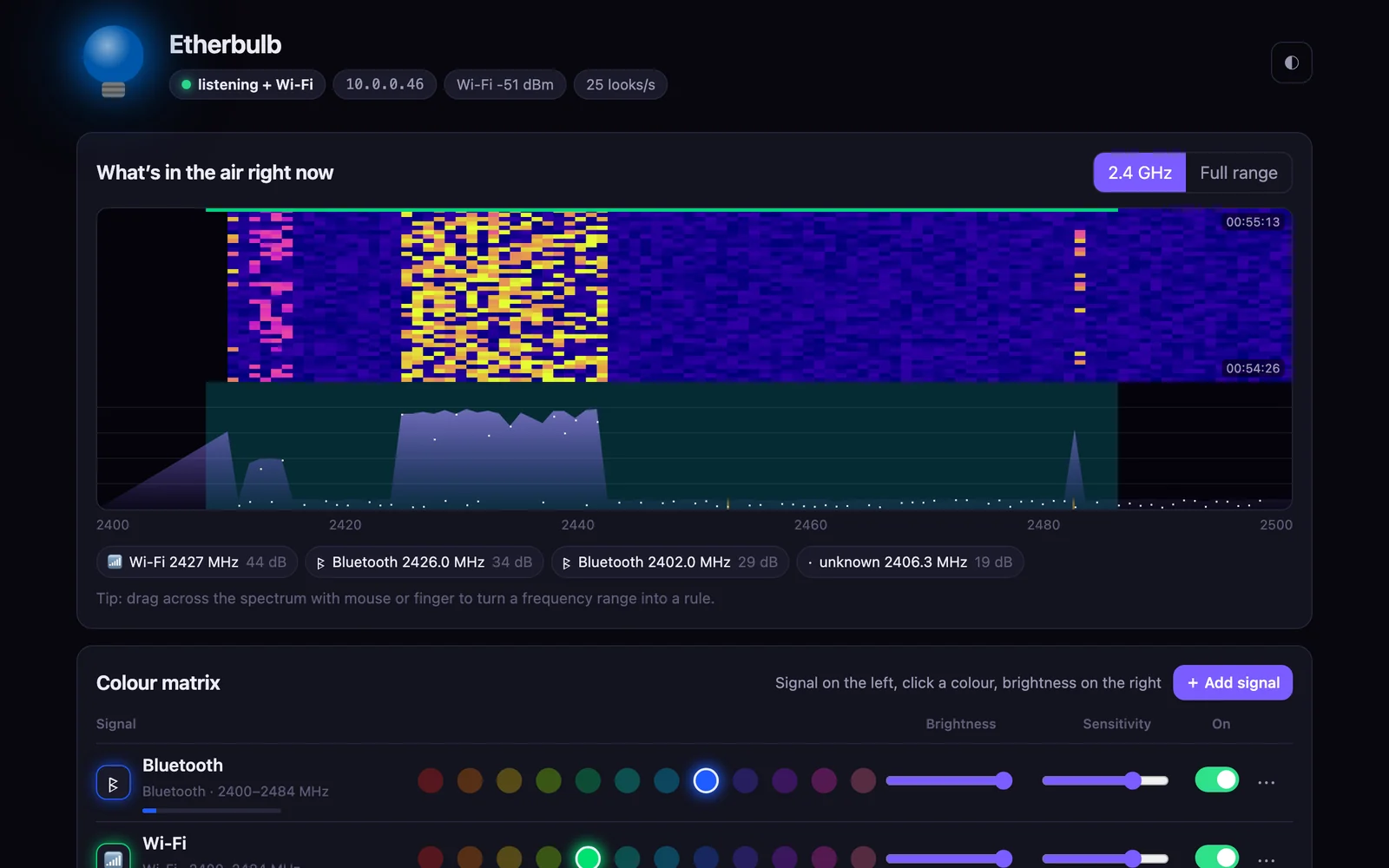
No app needed for everyday use: the bulb serves its own page at http://etherbulb.local. Live waterfall of the air, a colour matrix, presets for 26 signal types, and the mobile-network table from the ESPsoup app. Light and dark theme.
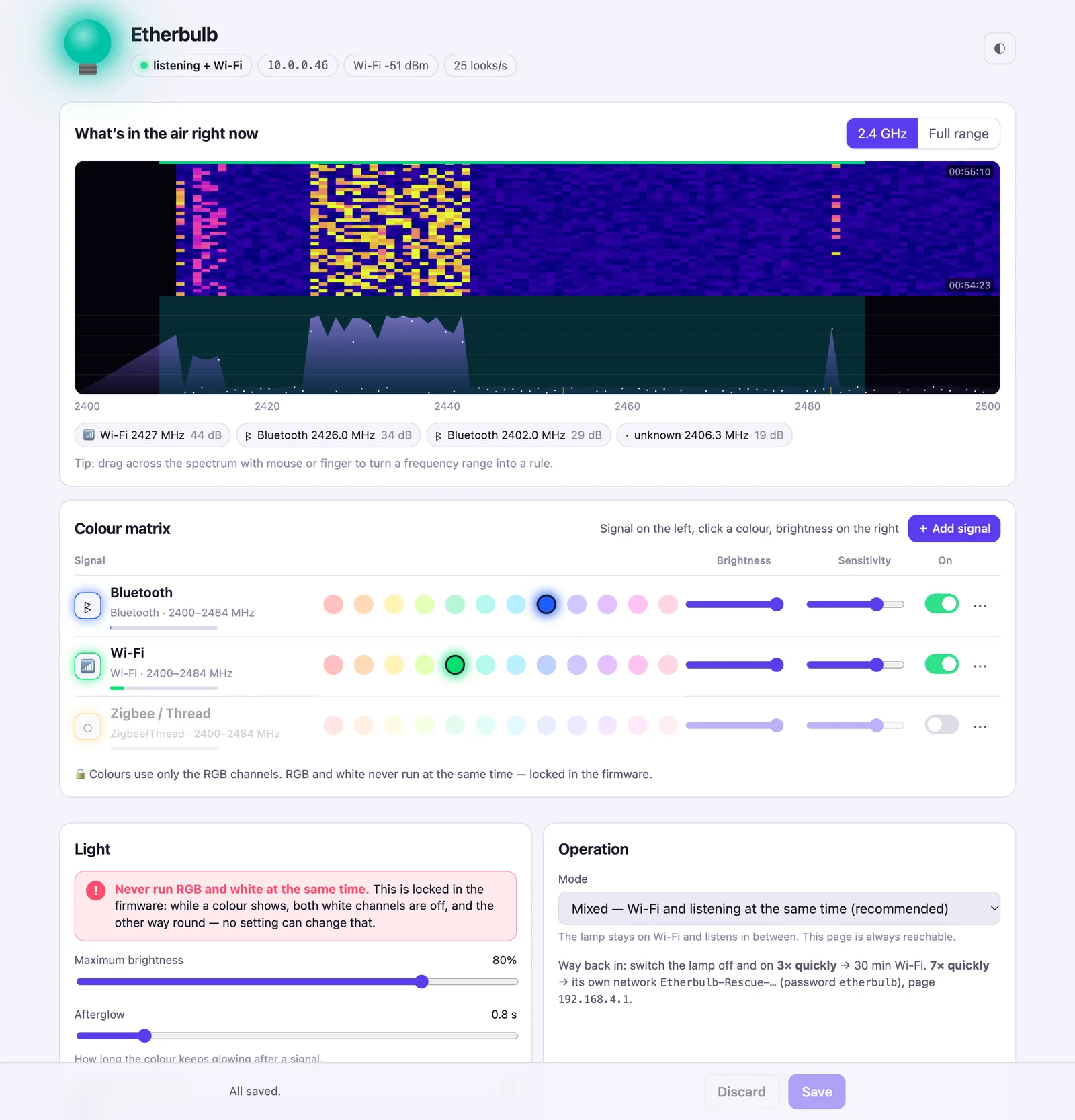
🎛️Colour matrix
One row per signal: click a colour, drag brightness and sensitivity, switch it on or off. Drag across the spectrum to turn any frequency range into a rule.
Which bulb do I need?
An E27 smart bulb with an ESP32-C3 inside and five LED channels (RGB + warm white + cold white). We build and test on the Athom LB01-12W-E27, sold on AliExpress under Athom's new name IoTorero. Watch out: the similar-looking LB03 and the 7 W / 15 W bulbs have an ESP8285, which cannot do this.
The bulb Ad · affiliate links
One bulb is all you need. The 2-pack is the usual offer; a second Etherbulb in another room is never wrong.
- 1×Athom / IoTorero 12 W RGBCW bulb, E27, ESP32-C3 – "Made for ESPHome"Model LB01-12W-E27-ESP. The ESPHome version flashes without opening the bulb (Improv over Bluetooth, then OTA). The Tasmota and WLED versions have the same chip and work too.2-pack on AliExpress ↗Amazon ↗eBay ↗alternative: the Tasmota 2-pack (AliExpress) ↗
Seen on 15 Oct 2026: the ESPHome 2-pack at 25 € on AliExpress (12.69 € per bulb, shipped from China in 5–10 working days). On Amazon and eBay we found no Athom bulb with ESP32-C3 so far; the buttons open a search there.
For LED strips: the SP530E controller Ad · affiliate links
Etherbulb also runs on the BTF-Lighting SP530E, a 5–24 V LED-strip controller with an ESP32-C3 and five PWM channels. Same firmware, same dashboard, any RGB or RGBCW strip. First flash over USB-serial (it ships with a different firmware).
- 1×BTF-Lighting SP530E, 12-in-1 Wi-Fi / Bluetooth LED controllerESP32-C3, 5 × PWM 6 A per channel (12 A total), 5–24 V. Pin assignment from the WLED community port, not yet verified on our own unit, so this one is for tinkerers for now.SP530E on Amazon ↗AliExpress ↗eBay ↗
Affiliate links (ad): Amazon, eBay and AliExpress. We may earn a commission on qualifying purchases at no extra cost to you. As an Amazon Associate we earn from qualifying purchases. Prices and availability change; check the shop before you buy.
Two minutes, no screwdriver.
Everything happens in your browser: the web flasher writes Etherbulb over USB (SP530E, dev boards) or guides you through the bulb's own update page. Bulbs that already run Etherbulb update themselves from their dashboard.
Web flasher
Chrome or Edge on a desktop, Chrome on Android. USB via Web Serial, Wi-Fi hand-over via Bluetooth, and a step-by-step guide for the bulb. live
Open the web flasherBulb from a phone
No Bluetooth needed: a factory bulb opens its own hotspot. Join it, enter your Wi-Fi, then upload Etherbulb on the bulb's page. Works on iPhone too. How ↗
Firmware
Etherbulb 0.1.0 for the Athom E27 bulb and the SP530E, GPL-3.0, with source. Ships without any Wi-Fi credentials: the bulb opens its own network Etherbulb-XXXX (password etherbulb) until you tell it yours.
/api/ota?wechsel=1. A Tasmota bulb moves its partition table to two slots on first boot, so later updates keep working. The web flasher walks you through it.A Wi-Fi chip, used as a radio.
📡Receiver
Etherbulb uses the ESP-SDR path discovered by ESPARGOS: an undocumented debug tap gives software access to the chip's raw I/Q samples at 80 MS/s. The bulb takes about 25 snapshots per second, each 200 µs long and 55 MHz wide, and runs a 256-point FFT over every 3.2 µs segment on the chip itself.
🧠Classifier
Signals are sorted by width and position: ≥ 8 MHz on the Wi-Fi grid is Wi-Fi, ≤ 2.6 MHz on the 1 MHz grid is Bluetooth, 1.5–3.8 MHz on 2405 + 5·n is Zigbee, many narrow peaks wandering over ±6 MHz is analog video. The bulb learns its own spurs (the ESP32-C3 has some at 2400, 2440 and 2480 MHz) and hides them.
📶Wi-Fi and listening at once
The radio belongs to either Wi-Fi or the receiver. Etherbulb saves the radio's analog state before each snapshot and hands it back right after, so the bulb stays on your network while it listens. Measured: 25 snapshots/s with 5 % ping loss. If Wi-Fi ever drops for a minute, the bulb falls back to taking turns.
🔓Open source
Firmware under GPL-3.0, built on ESP-SDR (ESPARGOS) and the signal tables of ESPsoup. Three emergency exits built in: switch the bulb off and on 3× quickly for 30 minutes of Wi-Fi, 7× for a rescue network with the update page, and after three crashes in a row it boots the previous firmware.
Keep the light on.
Etherbulb is a hobby project from the makers of ESPsoup. If it lights up your room, a small tip pays for test bulbs and a lot of coffee.
Questions people ask.
Does the bulb transmit anything?
Only as a normal Wi-Fi client on your network, so you can open its dashboard. The receiver part is receive-only: it never transmits on the bands it watches, and it never decodes contents, only the shape of signals.
Can I still use it as a normal lamp?
Yes. Set an idle light: warm white at any brightness when nothing is detected for a while, and colours only when something is in the air. Or switch rules off and you have a plain warm-white bulb with a web page.
Does it see my neighbour's Wi-Fi?
It sees that there is Wi-Fi on a channel and how strong it is. It cannot tell networks apart beyond their channel, and it does not read any packet.
Why not 5.8 GHz FPV?
The bulb's ESP32-C3 has no 5 GHz radio. The 2.4 GHz analog video channels (AV1–AV4, 2414–2468 MHz) work. For 5.8 GHz you want ESPsoup with an ESP32-C5 board.
What if I lock myself out?
Switch the bulb off and on three times quickly: it stays on Wi-Fi for 30 minutes. Seven times: it opens its own network Etherbulb-Rescue-XXXX (password etherbulb) with the settings and update page at 192.168.4.1.
Will it brick my bulb?
The flash goes into the second firmware slot; the previous firmware stays until Etherbulb has run for a minute. After three crashes in a row the bulb boots the previous image by itself. Tasmota bulbs keep their factory safeboot image. We have flashed bulbs back and forth between ESPHome, Tasmota, Funkl and Etherbulb many times; still, you do this at your own risk.
Is it legal to receive this?
Etherbulb only receives and shows that a signal exists. Rules on receiving radio and on what you may do with the information differ by country. Use it responsibly and at your own risk.
Legal
Etherbulb is an independent open-source project. It is not affiliated with Athom Technology / IoTorero, BTF-Lighting, Espressif Systems or the ESPARGOS / ESP-SDR project. ESP32 is a trademark of Espressif Systems. Flashing third-party firmware may void the bulb's warranty.